
An attic performance products contractor guide should do more than list products. It should help you inspect the job, identify the performance problem, choose a product that fits the assembly, install it according to the applicable instructions, and explain the recommendation clearly to the property owner. The Attic Depot supplies professional contractors with a portfolio that covers ventilation, radiant heat, insulation, roof restoration, attic access, odor treatment, and installation support.
Become a dealer with The Attic Depot to discuss contractor products, dealer support, training, technical questions, and wholesale access. Dealer pricing is shared with authorized dealers rather than published for public checkout.
What are attic performance products?
Attic performance products are products selected to improve one or more conditions in an attic or roof system. Those conditions can include excessive heat, inadequate or poorly distributed airflow, radiant heat transfer, air leakage at an attic entry, aging asphalt shingles, organic odor, or weather exposure around a roof penetration.
These products do not all solve the same problem. A solar attic fan addresses powered exhaust ventilation. A radiant barrier addresses radiant heat transfer. A multi-layer insulation product can combine reflective and insulating functions. A roof rejuvenation treatment is intended for a suitable asphalt-shingle roof, not a leaking or structurally failed roof. A stairway insulator treats an attic access opening. Good recommendations start by keeping those roles separate.
For contractors, the value is not simply adding another item to a truck. The right product can help you build a more complete scope of work, give the customer a clearer explanation of the building condition, and create a repeatable service that fits your existing roofing, insulation, HVAC, or energy-efficiency business.
Start with an attic performance assessment
Before selecting a product, inspect the attic as a system. A product can be technically well suited and still underperform if the airflow path is blocked, moisture is unresolved, the substrate is unsuitable, or the scope ignores a separate building condition.
Document the problem the customer wants solved
- Record whether the concern is heat, moisture, air leakage, odor, roof appearance, granule loss, an attic entry, or a combination of conditions.
- Ask when the problem occurs. Seasonal heat, a recent animal intrusion, a roof inspection, and a new HVAC installation point to different starting questions.
- Separate an observed condition from a proposed result. For example, a hot attic is an observation, not proof that adding exhaust capacity alone is the correct solution.
- Photograph relevant conditions and note roof age, roof type, attic access, insulation location, ventilation openings, equipment, and obstructions.
Check the airflow path and attic assembly
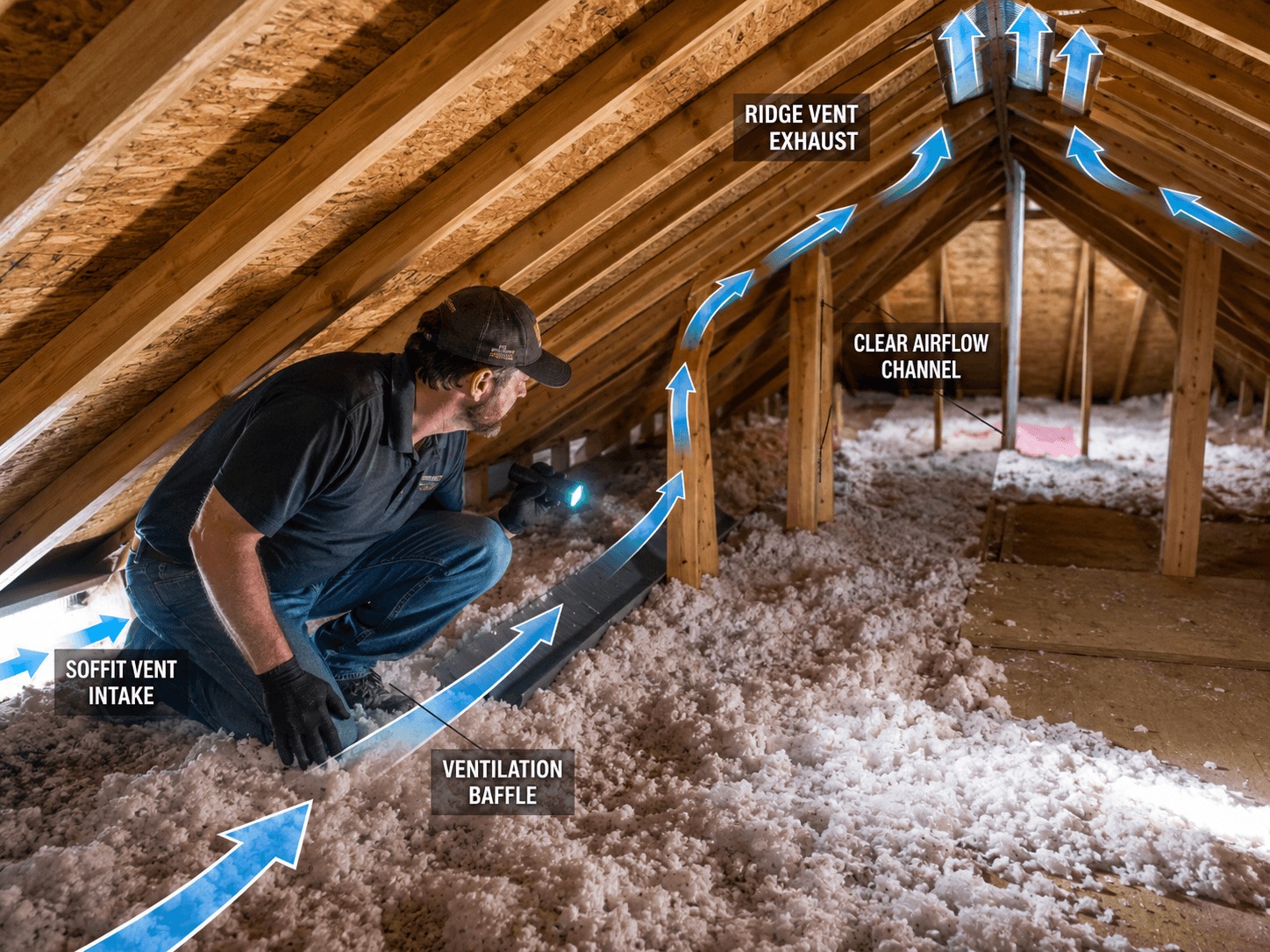
Inspect intake and exhaust paths rather than counting vents from the ground. Look for blocked soffit areas, compressed or missing baffles, disconnected pathways, divided attic zones, insulation covering intended openings, and roof or gable locations that limit product placement. The existing insulation, ductwork, roof deck, framing, and access opening all influence the recommendation.
The ENERGY STAR guidance on a well-insulated and sealed attic emphasizes addressing air leaks before adding insulation. That sequence is useful for contractor conversations because it keeps air sealing, insulation, and ventilation from being treated as interchangeable steps.
Know when to stop and refer
Do not use a specialty product to conceal active leaks, structural damage, unsafe wiring, contaminated material, a failed roof assembly, or a code issue that requires another trade or a design professional. Make the limitation part of the proposal. A clear no-go decision protects the customer, the installer, and the credibility of the recommendation.
How to choose the right product category
Use the assessment to match the problem to a product role. The following framework is designed for contractor conversations and job planning. It is not a substitute for the exact product documentation, the roof manufacturer's requirements, or local code and permitting requirements.
Solar attic fans for powered exhaust ventilation
The Attic Depot solar attic fan line includes roof-mount and gable-mount options. Model selection should consider the documented airflow capacity, attic layout, solar exposure, mount type, controls, roof construction, and regional requirements.
- The 25W roof-mount model is a compact option with a fixed panel, up to 1,365 CFM, and coverage guidance for attics up to 1,300 square feet. It has an automatic thermostat and no humidistat.
- The 30W roof-mount model provides up to 1,550 CFM, an adjustable panel, thermostat and humidistat controls, and coverage guidance for attics up to 1,500 square feet. Its product documentation identifies Florida and Texas windstorm certifications and TAS-100 certification. Confirm the exact current documentation for the job.
- The 70W roof-mount model provides up to 3,850 CFM, an adjustable panel, thermostat and humidistat controls, and coverage guidance for attics up to 2,500 square feet. It can be considered for a large attic or a layout where two smaller fans are not practical.
- The 30W gable-mount model provides up to 1,550 CFM with a remotely mounted solar panel and is intended for a suitable gable application. It can avoid a roof penetration for the fan housing, but the gable opening and panel location still need to be assessed.
These figures are model-specific published specifications, not a universal design rule. Use the solar attic fan selection hub and the exact model documentation when you compare a job. The rated CFM does not establish the project's target CFM, prove adequate intake, or override a local requirement.
Shingle Serum for suitable roof rejuvenation work
Shingle Serum is a tall oil-based roof rejuvenation treatment with added polymers. It is designed to penetrate asphalt shingles and help restore flexibility as part of a roof restoration scope. It is not a repair for structural failure, active leaks, missing shingles, severe curling, or a roof that has reached the end of its useful service life.
Good candidates have a structurally sound asphalt-shingle roof with signs of aging, such as a faded appearance, dry or brittle shingles, or moderate granule loss, while still passing the contractor's inspection. The product material identifies an approximate 8-to-20-year candidate range, but the condition of the actual roof should control the decision. If algae or stains are present, apply Roof Cleaner first as the preparation step identified in the product guidance.
Shingle Serum can be applied with equipment ranging from a backpack sprayer to a full soft-wash system. The product guidance identifies low-pressure, high-volume application. Document the roof condition before treatment, explain what the product can and cannot address, and keep the limited seven-year manufacturing-defect warranty separate from any workmanship warranty you offer.
RadiantX for radiant heat at the roof deck
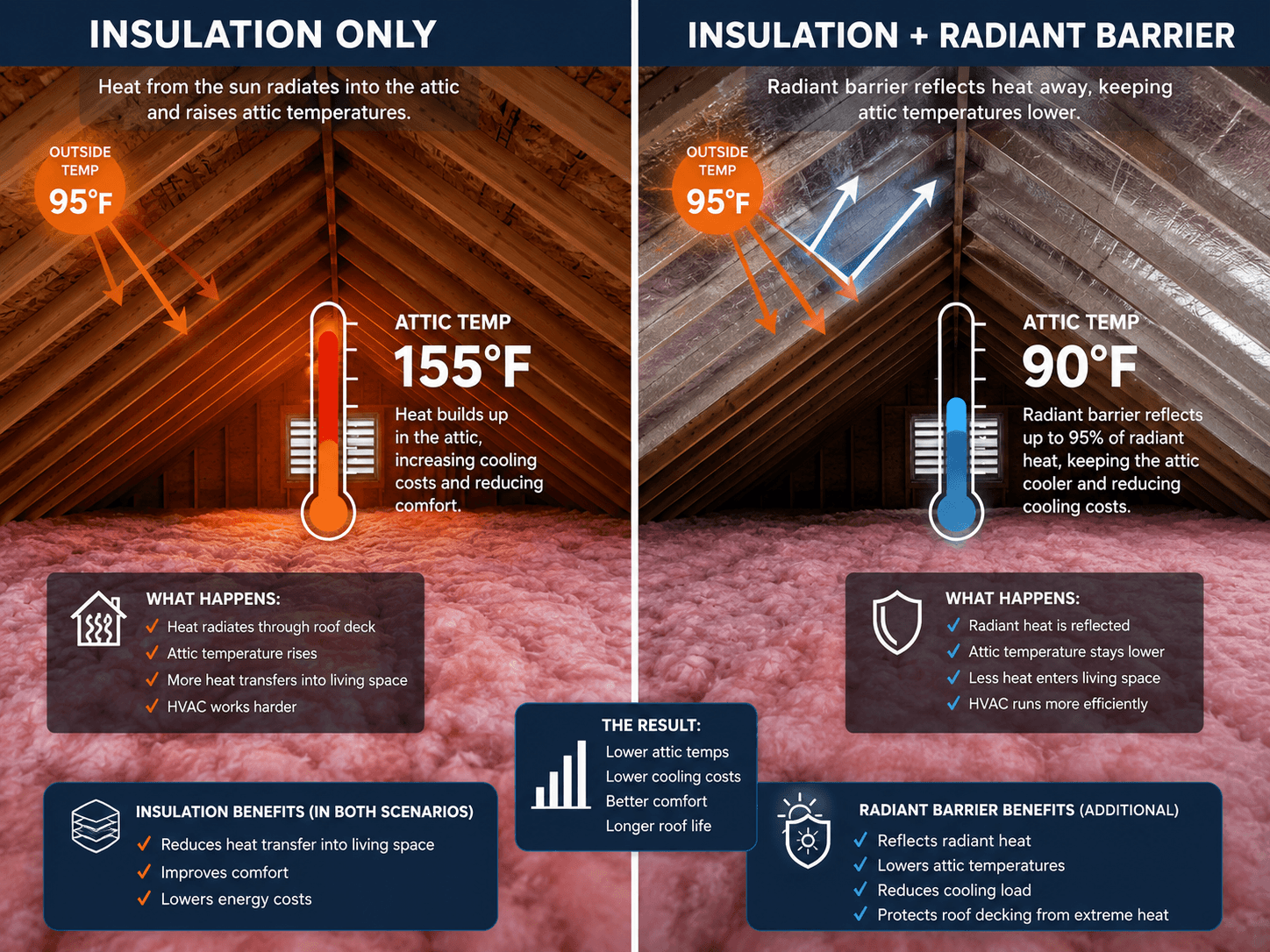
RadiantX is a spray-on radiant barrier applied to the underside of roof decking. Its role is to reflect radiant heat before it enters the attic space. It complements insulation rather than replacing every other form of insulation, because radiant and conductive heat transfer are different parts of the building-science conversation.
The product guidance identifies a traditional airless sprayer with a 619 or 621 tip and a two-part kit covering approximately 1,500 square feet. Confirm substrate condition, access, ventilation, preparation, coverage, drying, and the current product instructions before beginning. If you need to explain the broader category to a customer, the Building America Solution Center guide to attic radiant barriers describes common installation locations and why a radiant barrier should be evaluated with the rest of the attic assembly.
ComfortShield MLI for combined reflective and insulating functions
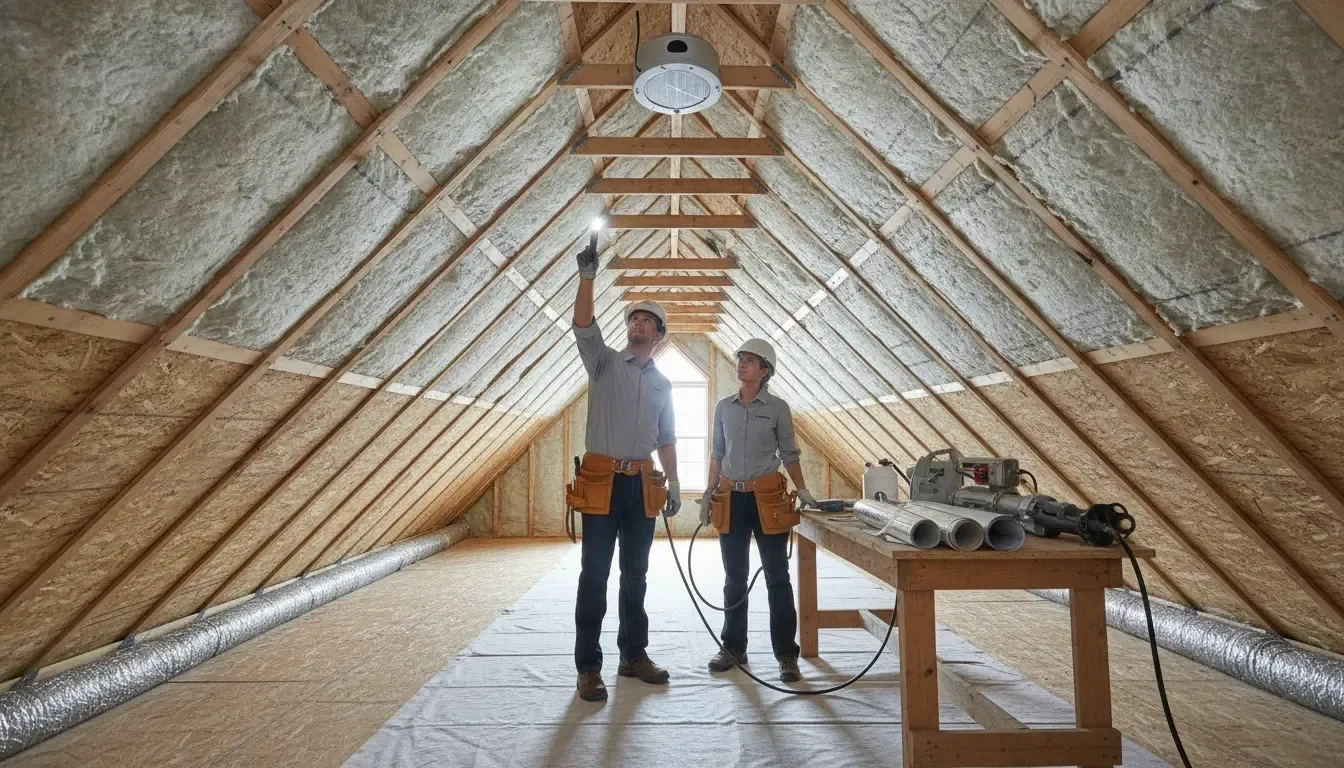
ComfortShield Multi-Layer Insulation combines reflective foil surfaces with a 3mm fiberglass insulating core. The product is designed to reflect radiant heat and provide additional thermal resistance in one material. Depending on the assembly and product instructions, it can be installed over existing attic-floor insulation or stapled to the underside of roof decking in retrofit and new-construction applications.
Do not describe ComfortShield as identical to a sheet radiant barrier or as a replacement for every insulation requirement. Confirm the installation location, fastening method, clearances, seams, penetrations, and the building assembly before you quote the scope. The ComfortShield product page is the correct place to review the current product description and application information.
Draft Master for attic stairways, hatchways, and scuttle holes
Attic access openings are easy to overlook during an insulation or air-sealing project. Draft Master is an insulated cover designed to seal and insulate attic stair openings, reduce energy loss, block drafts, and help keep dust or insulation particles from entering the living space.
Measure the opening and identify the access type before ordering. The product line includes configurations for pull-down stairs, hatchways and scuttle holes, and walk-through doorways. The available sizes vary by configuration, so never assume that a nominal opening measurement is enough. The Draft Master page should be checked for the current size and installation information. Its listed warranty is a 10-year limited warranty against manufacturing defects, subject to the applicable terms.
Attic Fresh Enzyme for organic odor treatment
Attic Fresh Enzyme is a bio-enzymatic odor treatment for conditions associated with rodent activity, nesting materials, animal waste, bacteria, and other organic contaminants. Its purpose is to treat odor sources rather than simply mask them with fragrance. The formula has a fresh citrus scent and is applied with a standard pump sprayer.
Build the scope around the contamination condition. Coordinate removal of affected materials, exclusion or pest-control work, cleaning, drying, and any insulation replacement that the job requires. The product can be sprayed over insulation or onto attic floors, joists, roof decking, and affected surfaces according to the application guidance. Use the Attic Fresh product page and current instructions to confirm the proper application.
Roof Cleaner and Premium Solar Sealant as supporting products
Roof Cleaner is a professional-strength treatment for algae, mold, mildew, black streaks, and surface staining. It can be offered as a standalone roof-cleaning service or used to prepare a suitable asphalt-shingle roof for rejuvenation when the product instructions call for it.
Premium Solar Sealant is a contractor-grade, black, UV-resistant sealant developed for The Attic Depot solar attic fan installations. It is intended to create a clean, weather-resistant seal around the fan roof penetration and to accommodate normal roof movement. Use it for the intended installation context and do not generalize its properties to unrelated roof repairs.
Talk with The Attic Depot about your contractor product plan when you need product documentation, training, shipping information, or help matching a job to the available product portfolio. The Attic Depot's contractor-first model is built around supporting dealers rather than selling directly to homeowners.
Installation planning and compliance checks
A professional installation guide should tell the crew what to verify before tools come out. The exact sequence depends on the product, but the planning discipline is consistent.
Use a pre-installation checklist
- Confirm the product, model, quantity, dimensions, and intended application against the current manufacturer documentation.
- Inspect the substrate and surrounding assembly. Record moisture, damage, contamination, loose material, obstructions, and access limitations.
- Confirm that the work area is safe to enter and that required personal protective equipment, fall protection, ventilation, and electrical safety measures are in place.
- Map penetrations, wiring, ductwork, framing, insulation, vents, and other conditions that could affect the installation.
- Confirm the sequence with other trades. Roof cleaning, pest exclusion, air sealing, insulation, ventilation, and finish work should not be scheduled as if they are one interchangeable operation.
- Photograph the starting condition and record the products, lot information when applicable, installation date, and any customer-approved exclusions.
Plan solar fan installations around the whole airflow path
For a solar fan, confirm the model's mount, panel position, roof exposure, exhaust location, intake path, and regional certification needs. A roof-mount fan needs a suitable roof location and a properly prepared penetration. A gable-mount fan needs a suitable gable opening and a panel location with appropriate solar exposure.
Use the exact model's documented CFM and coverage guidance when calculating a starting quantity. Do not treat wattage as airflow, and do not add exhaust capacity without checking intake. The recent solar attic fan sizing guide explains why the target CFM, model rating, placement, intake, and roof conditions all belong in the recommendation.
Sequence roof-care work carefully
For a roof-care scope, inspect first, clean when required, allow the roof and surrounding conditions to meet the product instructions, and then apply the rejuvenation treatment if the roof is a good candidate. A clean-looking roof is not automatically a structurally sound roof. Document exclusions for leaks, damaged decking, missing shingles, severe curling, or other conditions outside the treatment's intended use.
Keep radiant products and insulation in the correct roles
RadiantX and ComfortShield should be described in terms of where they work in the assembly and what type of heat transfer they address. Confirm the attic's existing insulation, roof-deck condition, access, clearances, and ventilation before selecting an installation location. Never promise a universal energy-savings percentage or imply that one product eliminates the need to meet applicable insulation, ventilation, or fire-safety requirements.
Coordinate access and odor scopes
Draft Master work should begin with accurate measurements and an opening condition that can accept the cover. Attic Fresh work should begin with the contamination source and the removal, exclusion, cleaning, or insulation decisions that surround the treatment. Treating odor while leaving the source in place is not a complete remediation plan.
Separate product warranties from workmanship
Explain the distinction in writing. The Attic Depot materials identify product-specific limited warranties against manufacturing defects for certain products, including lifetime coverage for solar fans, a seven-year limited warranty for Shingle Serum, a lifetime limited warranty for RadiantX, and a 10-year limited warranty for Draft Master. Solar-fan coverage is against manufacturing defects and does not include labor. Warranty terms, exclusions, and covered products can change, so confirm the current warranty document before making a promise to a customer.
How contractors can sell a complete attic-performance scope
Technical accuracy builds trust, but customers also need a simple explanation of why the work belongs on their project. The strongest sales conversation connects an observed condition to a defined product role and a documented installation plan.
Ask discovery questions before presenting a product
- What condition led you to request the inspection or estimate?
- Is the priority heat, moisture, odor, roof appearance, access, comfort, or energy loss?
- What has already been repaired, cleaned, replaced, or added in the attic?
- Is the attic vented, divided into multiple zones, or used for equipment and storage?
- What roof material, age, exposure, and visible damage did the inspection identify?
- Does the project have windstorm, permitting, manufacturer, or building-code requirements that must be confirmed before specifying?
Explain the product as part of the solution, not as a magic fix
Use plain language: the solar fan provides powered exhaust when the attic and intake path support that application; RadiantX works at the roof deck to address radiant heat; ComfortShield combines reflective and insulating functions; Draft Master treats the attic access opening; Roof Cleaner prepares or improves a roof-care scope; Shingle Serum is for a suitable aging asphalt-shingle roof; and Attic Fresh addresses organic odor conditions as part of a broader remediation plan.
This approach prevents overpromising. It also gives the customer a reason to understand the sequence, approve the correct scope, and recognize why a lower-cost product that does not fit the condition is not necessarily the better recommendation.
Build a written scope the crew can repeat
List the observed condition, selected product, quantity or coverage basis, installation location, preparation work, exclusions, warranty information, and customer responsibilities. Include photographs and a simple before-and-after explanation. When a product requires an exact model instruction, certification, or local review, name that verification step instead of implying it has already been completed.
Use dealer support as part of your operating model
A contractor's product decision includes more than the material. Reliable supply, technical support, training, marketing resources, sales tools, warranty guidance, and shipping all affect whether a new service can be delivered consistently. The Attic Depot offers free ground shipping in the continental United States and same-day shipping for orders placed by 2:00 PM Central on business days, subject to the company's current terms. Authorized dealers can access pricing and support without a public consumer checkout model.
That partnership model matters when you are building a service around a specialty product. The Attic Depot does not sell directly to homeowners, so contractors can present the product and own the customer relationship without a supplier competing for the same homeowner transaction.
Questions contractors ask before specifying attic products
Should a contractor start with ventilation, insulation, or roof restoration?
Start with the observed condition and the attic assessment, not a product category. Check the airflow path, roof and substrate condition, existing insulation, moisture, access, and contamination. Then choose the product role that addresses the condition and sequence the work with any required repairs or preparation.
Can one attic product solve every performance problem?
No. Ventilation, radiant heat, conductive insulation, air leakage, roof aging, attic access, and organic odor are different conditions. A complete scope may use one product or several, but each product should have a defined job and documented reason for inclusion.
How should a contractor compare solar attic fan models?
Compare the exact model's rated CFM, coverage guidance, mount type, panel configuration, controls, roof exposure, installation requirements, and applicable certifications. Do not use wattage alone, and do not assume that a certification or feature listed for one model applies to every model.
Can Shingle Serum be used on a roof with active leaks?
Do not present Shingle Serum as a repair for active leaks or structural roof damage. Inspect the roof, address conditions outside the product's intended use, and recommend rejuvenation only when the asphalt-shingle roof is a suitable candidate under the current product guidance.
Is a radiant barrier a replacement for insulation?
Not automatically. Radiant barriers and insulation address different heat-transfer mechanisms. Evaluate the existing assembly, climate, roof deck, attic-floor insulation, and product instructions. Explain the role of the selected product without promising that it replaces every insulation requirement.
What should a contractor do when a product does not fit the job?
Say so and document why. A professional recommendation can be a repair, a different product, another trade, a code review, or no installation until the condition is corrected. Honest limits protect the customer's property and create stronger long-term trust than forcing a product into an unsuitable scope.
Build a repeatable contractor process
The most useful attic performance products contractor guide is ultimately a process: inspect the assembly, define the condition, select the product role, verify the exact documentation, plan safe installation, explain the limits, document the scope, and provide a clear path for support. This process helps roofing, insulation, HVAC, and energy-efficiency contractors add specialty services without turning every estimate into a one-off experiment.
Apply to become a dealer for free dealer enrollment with no contracts and no order minimums. The Attic Depot can help authorized contractors access product information, training, marketing and sales resources, technical support, shipping assistance, and a contractor-first wholesale relationship.